How Optiply automates your replenishment with agentic AI: from business case to reality

Most teams never fully automate because they constantly tweak reorder points, safety stock and lead times. Optiply’s supply chain agent uses all your data, guardrails and years of purchasing insights to execute the right replenishment decisions automatically.

Used by 500+ e-commerce, retail and wholesale businesses that replenish daily

32%
less inventory

Optiply is a powerful inventory system that ensures that you achieve the desired service level – with as little inventory and as little costs as possible. That is exactly what it is all about.

Martin Alserda

Head of Purchasing

Case Study
80%
less times saying no

“The fact that Optiply makes the calculations, analyses the sales of the past few years and can therefore make a prediction saves me a lot of work. That time saving is really the trigger.”

Martijn Janssen

Buyer & Sales Manager

Case Study

We can now order faster and better, and our stock levels are also increasingly accurate. You actually see that directly reflected in the business results.

Ewout Gordijn

COO

Case Study

“By scaling up, we have been able to make a specialist range profitable.”

Bart Bouter

CEO

Case Study
50%
less backorders

"What used to take a whole day now takes our buyers 15 mins, thanks to automating 92% of our process, whilst we’ve also cut our backorders in half and saved 20% on inventory."

Randy Hatzmann

Operational Manager

Case Study
95%
availability of A-products

“Optiply clearly shows which brands are up next, which SKUs are needed, and the quantity required for the upcoming period. Now, I no longer have to think about what needs to be ordered.”

Tygo Bril

Purchaser and Process Improvement Specialist

Case Study
01

Connect all your data sources for reliable advice

Retrieve sales, inventory and supplier data from your ERP, WMS and CMS. Add delivery times, minimum order values and purchasing times so that Optiply takes into account all relevant variables.

02

Conduct your ABC analysis for an optimal purchasing strategy

Prioritize products based on margin, revenue and sales frequency and determine your desired product availability and inventory levels. Optiply will calculate scenarios and automatically advises you on an optimal purchasing strategy.

03

Optiply determines when, where and how much to buy in

The dynamic calendar automatically shows which purchase orders are needed based on historical sales data, trends, delivery times and inventory, using AI and 40+ forecasting methods.

04

Review the advice and adjust as needed, or order directly

The results don't lie, but transparency is key. Dive into the data behind each procurement recommendation at the SKU level. Do you agree with the recommendation? You can forward orders to your suppliers in one simple click.

05

Experience the impact of Optiply on your procurement strategy

Compare your current procurement strategy with Optiply's advice. Receive insight into your ROI and business case during a strategy call at the end of your trial.

06

Achieve more sales, reduce inventory & automate purchasing

Once you’re continuously using Optiply for your purchasing, the system keeps learning from all your data. Within weeks, it optimizes your service levels and fully automates your procurement. You focus on strategy, suppliers and product assortment — Optiply takes care of the rest.

From data to automatic purchasing in 7 steps

1
Connect your data
Retrieve sales, inventory and supplier data from your ERP, WMS and CMS. Add delivery times, minimum order values and purchasing times so that Optiply takes into account all relevant variables.
2
Data gets checked and cleaned
The supply chain agent runs automatic checks, flags inconsistencies and cleans up what's there, so every purchasing decision that follows is built on reliable information.
3
Set an optimal inventory strategy
The supply chain agent helps translate your business goals into an optimal inventory strategy. Products get prioritised based on margin, revenue, and sales and define your desired availability and stock levels.
4
Automate purchasing decisions
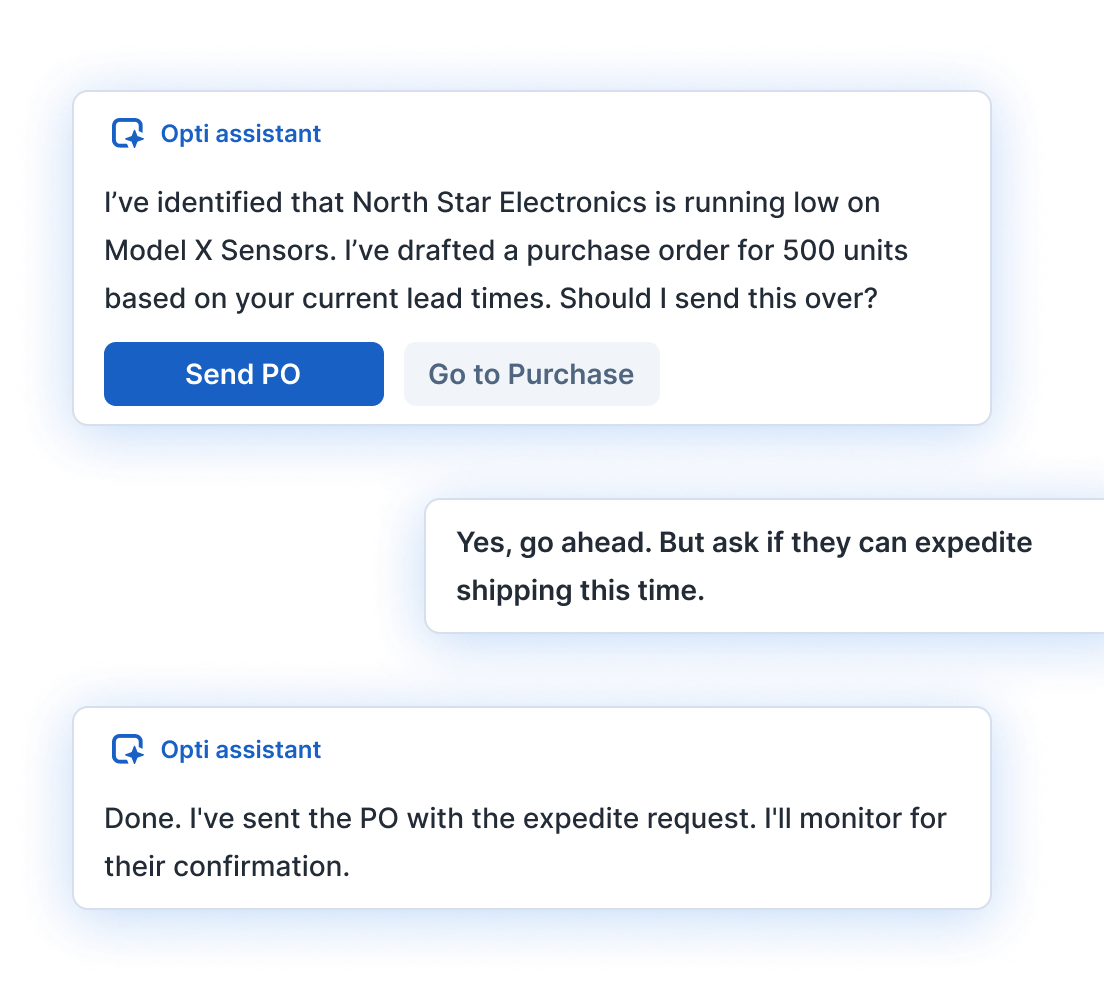
The supply chain agent learns about your specific buying process and translates the strategy into daily purchasing decisions. It explains every recommendation on SKU level, and will involve you when decisions fall outside agreed guardrails.
5
Business case
Compare your current procurement strategy with Optiply's advice. Receive insight into your ROI and business case during a strategy call at the end of your trial.
6
Handle supplier communication
Forget about the back-and-forth with suppliers. The supply chain agent places orders and manages communication, including emails, follow-ups and confirmations across all your suppliers.
7
Continously optimise inventory
The more you rely on your supply chain agent for purchasing, the more it learns from your data and manual adjustments. Within weeks, it improves service levels and automates procurement while keeping you in the loop.

Everything you need to avoid lost sales and strengthen your cash flow

Strategic inventory optimisation goes beyond purchasing. Discover how Optiply optimises your entire procurement process.

Multi-supplier

Optiply chooses the best supplier for each order and determines exactly what, when and how much to buy.

Adjust your inventory to seasonal peaks

Stay ready for fluctuations in demand, maximising sales and preserving your profit margins.

Negotiate with suppliers based on data

Optiply connects supplier data to your purchasing strategy and provides insight into order quantities and delivery times for better procurement negotiations.

Get insight into lead times

See how long a product stays in your warehouse before it’s sold and determine if your inventory levels are optimal.

Order period

Optiply takes into account the minimum order quantities from your suppliers and can also track their supply schedules to balance inventory and purchasing costs.

Be the first to know if stock-outs are on the horizon

Optiply flags delays or unexpected peaks in demand and advises you to place an emergency order in time.

Frequently asked
questions

Still have questions about Optiply? Find below answers to the most frequently asked questions.

Who is Optiply made for?

Optiply delivers the most value to e-commerce, wholesale and retail businesses with large assortments (often greater than 5000 SKUs) that purchase daily.

Companies using Optiply have annual sales of €500K to €500M.

Who is eligible for a free business case?

E-commerce companies, wholesalers and retailers using any of Optiply's standard integrations can easily sign up for the trial period, even without a credit card, and work toward the free business case.

How is the purchasing advice determined?

Optiply's AI purchasing algorithm includes more than 40 different calculations. Among other things, the purchasing recommendation includes real-time data from: sales data, ABC categorisation, seasons, trends, peaks, (actual) delivery times and more!

Multiple holidays and seasons per industry are also included, and we also combine the knowledge and data of all our customers (fully anonymised).  Even though a product may seem new, the algorithm has seen (similar) products before.

What does the free business case look like?

At the end of your trial period, we hold a strategy meeting to measure your current product availability and inventory levels.


We then run different scenarios to demonstrate exactly how improvements in these areas can generate extra revenue, higher margins, or free up cash flow from your inventory.

Optiply calculates a concrete ROI instantly, so you know precisely what you stand to gain, without the manual analysis.

What is the difference with a min/max approach?

A simpler purchasing algorithm, such as a min/max approach, uses static, outdated data and calculates on the average of the past month to forecast inventory for the coming months.

This means that changes in demand, peaks, seasonal trends and market conditions are not accounted for. The result: frequent under- or overstocking, and the risk of lost sales or wasted inventory.

Optiply, on the other hand, works with data updated in real-time, so our forecasts are always current and react immediately to changes. This ensures that your inventory is optimal and you don't risk losses due to under- or overstocking.

Want to see how much you can save with Optiply compared to a min/max module? Calculate the difference here.

When can I start purchasing with Optiply?

Once the integration is finished and the settings are customised for your operation and goals, you can immediately start purchasing with Optiply. During the trial period, you can already place your first purchase orders. Once your strategy and purchasing moments are properly aligned, Optiply will start optimising your purchasing recommendations, you will be able to forward suggested replenishment orders as-is to your suppliers and directly experience the benefits.

Your team shouldn’t spend their days on manual purchasing

Free them up for supplier negotiations and strategic growth while Optiply executes the right purchasing decisions automatically and keeps inventory balanced.

Get a demo

“Optiply helps us avoid unnecessary inventory and [...] the service levels for our A-category has gone up significantly.”

Rody Hermkens

E-commerce specialist, Logistiekconcurrent